
Crawford Criminal Court Records
A Crawford County criminal court record is the court file for a prosecution. The clerk's Criminal Division files misdemeanor and felony criminal cases, including citations, accusations, indictments, pleadings, GCIC reports, traffic reports, prisoner reports, bond forfeitures, warrants scanned by the clerk, and grand jury presentments. Once the case is filed, the record can grow to include arraignment entries, motions, notices, orders, plea papers, trial activity, sentencing sheets, probation terms, and the final disposition.
The main local case file for serious criminal matters is tied to Crawford County Superior Court, Georgia's general-jurisdiction trial court. Crawford Superior Court is part of the Macon Judicial Circuit with Bibb and Peach Counties. Magistrate Court handles arrest and search warrants, pre-warrant hearings, first appearances, bond hearings, preliminary hearings, county ordinance cases, animal control violations, and some bad-check misdemeanors. Roberta Municipal Court handles city traffic and ordinance cases. A jail booking record can point to a criminal case, but the court file is the source for the case outcome.
Search Crawford Criminal Records
Start with the Crawford County Clerk of Superior Court for Superior Court criminal case files. The clerk's case-search link goes to Icon Case Management, which is login and captcha gated. If the user does not have access credentials, the practical route is a direct clerk request by phone, mail, or counter. Court calendars may confirm that a criminal status conference or criminal motion calendar exists, but calendars do not supply the full criminal file.
- Confirm the court level. Felony and Superior Court criminal files route through the Clerk of Superior Court.
- Check the clerk's case-management link if login access is available.
- Use the clerk's calendar page to confirm public criminal status or motion settings.
- Call the clerk with the defendant name, case number if known, charge, and approximate filing or hearing date.
- Request certified copies when a plea, sentence, disposition, or order must be used for an official purpose.
For charge-level detail visible at booking, use the sheriff jail population report and the separate court charge records page. For active custody, use inmate records. For all civil, probate, magistrate, and municipal channels, use court records.
Crawford Criminal Case Flow
A criminal court record changes as the prosecution moves from charge filing to final outcome. The arrest or citation can happen first, but the court record becomes the main source once an accusation, indictment, citation, or related pleading is filed with the court. In Crawford County, felony prosecutions are associated with Superior Court and the Macon Judicial Circuit. Early steps may include Magistrate Court events such as first appearance, bond, or preliminary hearing.
Case flow: Charges Filed › Arraignment › Pretrial / Motions › Plea or Trial › Disposition › Sentencing
| Stage | What Happens |
|---|---|
| Charges filed | An accusation, indictment, citation, or related pleading places the charge in the court record. |
| Arraignment | The defendant responds to the charge, and a plea may be entered. |
| Pretrial / motions | The court may hear motions, address discovery, set status dates, or resolve bond and scheduling issues. |
| Plea or trial | The case may end by plea, trial verdict, dismissal, or another final action. |
| Disposition / sentencing | The court record shows the result and sentence terms when the case reaches that stage. |
Crawford Criminal Record Fields
The public research did not expose an open Superior Court criminal case sample because the case-management portal is gated. The clerk's Criminal Division description, calendars, and jail roster charge fields still show the kinds of criminal data that must be verified in the court file. A criminal court record should be read as a case-level file. Booking charges, warrant numbers, and bond fields may point to the case, but the clerk's file controls the formal court history and disposition.
| Field | What It Shows |
|---|---|
| Defendant | The person charged in the criminal court case, subject to public-access limits and redaction rules. |
| Charging document | The citation, accusation, indictment, or pleading that states the formal charge. |
| Statute and charge | The O.C.G.A. statute and description associated with each count when included in the record. |
| Bond or warrant activity | Bond forfeitures, warrants scanned by the clerk, first appearances, or related court events. |
| Plea and motions | Plea entries, motion filings, motion hearings, and court orders. |
| Disposition | Dismissal, plea, verdict, nolle prosequi, sentence, probation, or other current/final result. |
| Sentence | Jail, prison, probation, fines, conditions, or other terms if a sentence has been entered. |
Charges vs Convictions
A charge is an allegation filed or pursued in court. A conviction is a final outcome based on a guilty plea, verdict, or other adjudication that counts as a conviction under the applicable law. A Crawford County criminal court record can include charges that were amended, reduced, dismissed, or not proven. That is why a booking charge, accusation, or indictment should not be read as the final result without checking the disposition.
| Charge | Conviction | |
|---|---|---|
| Stage | Filed before the final outcome. | Entered after plea, verdict, or adjudication. |
| Meaning | An allegation or count in the case. | The court result that establishes guilt or legal responsibility. |
| Record risk | May be pending, amended, dropped, or dismissed. | May trigger sentence, probation, fines, or DDS reporting for traffic-related crimes. |
Dispositions and Sentences
Disposition means the court's result for a case or charge. In a Crawford County criminal court record, disposition language may show that a charge is guilty, not guilty, dismissed, nolle prossed, transferred, pending, or otherwise resolved. Sentencing information may include jail or prison time, probation, fines, conditions, credit for time served, bond forfeiture consequences, or reporting to state agencies. The clerk's Criminal Division also reports prisoner information to the Department of Corrections when required.
The GBI criminal history record restriction page explains Georgia's process for limiting access to eligible criminal history entries.
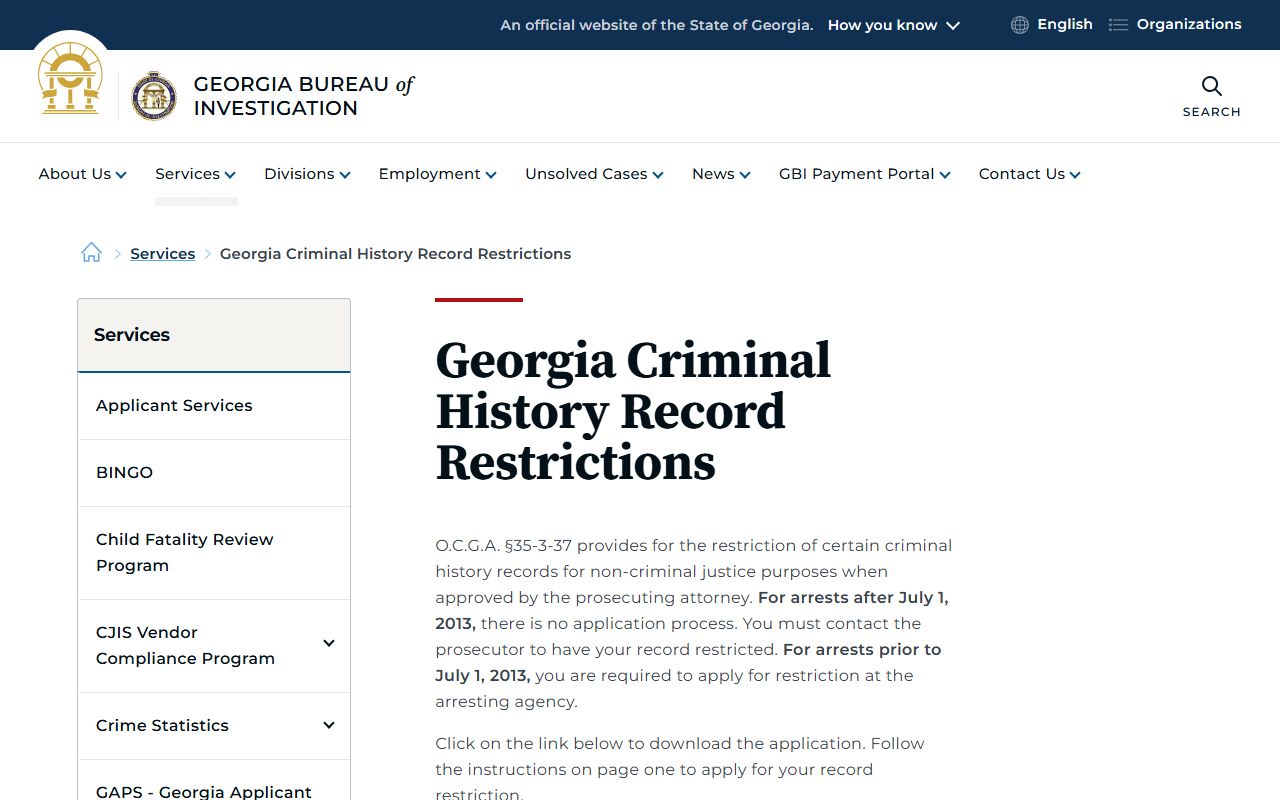
For Crawford criminal cases, restriction questions may still need the prosecutor, arresting agency, or court that handled the case.
Sealed vs Restricted Records
Georgia public materials use the term record restriction for many criminal-history access limits. O.C.G.A. 35-3-37 allows eligible criminal history information to be restricted from non-criminal-justice access. For arrests after July 1, 2013, GBI states there is no application process through GBI and the person must contact the prosecutor. For arrests before that date, the applicant must apply at the arresting agency. Court-file sealing may require a separate court order.
| Restricted Criminal History | Sealed Court File | |
|---|---|---|
| Where it applies | GCIC or Georgia criminal history access. | The court file or parts of the court file. |
| Main source | GBI guidance, prosecutor, or arresting agency. | The court that handled the case. |
| Effect | Limits public or noncriminal-justice access. | Limits access to the case document or docket details. |
Public Criminal Record Access
Georgia's Open Records Act, O.C.G.A. 50-18-70 et seq., creates the general state framework for public records. Criminal court files can still be affected by court rules, juvenile law, sealed orders, criminal-history restriction rules, and law-enforcement exemptions. O.C.G.A. 15-11 juvenile provisions and related access rules mean juvenile matters cannot be treated like ordinary adult criminal files.
Key Statutes:
O.C.G.A. 50-18-70 et seq. sets Georgia's public-records framework for inspection and copying, subject to exemptions.
O.C.G.A. 35-3-37 governs restriction of eligible Georgia criminal history information.
DA and Defense Context
Criminal prosecutions in Crawford Superior Court connect to circuit-level offices. The Macon Judicial Circuit District Attorney serves the circuit, and the Georgia Public Defender Council has a Macon Circuit public defender office. These offices may appear in criminal case records, but they do not replace the Crawford Clerk of Superior Court as the court-file custodian. The clerk remains the place to request filed accusations, indictments, orders, dispositions, and certified court copies.
The Macon Circuit Public Defender identifies the circuit indigent-defense office serving Crawford County.

That distinction matters because defense representation, prosecution, and record custody can involve different offices.
Restricted Crawford Criminal Records
Restricted criminal records include juvenile matters, sealed files, redacted personal identifiers, eligible restricted criminal history entries, and records affected by pending-investigation or law-enforcement exemptions. The clerk's Juvenile Division handles delinquency and juvenile traffic matters, but those records have special access limits. Jail roster records redact addresses and do not show sensitive fields such as Social Security numbers, medical status, jail classification, or full birth data.
Important: A criminal court record is not an FCRA consumer report and should be verified with the originating court.